Friday, 6 December 2013

Alvar Aalto

Alvar Aalto was a finish architect and furniture designer, his most important collaborator was his wife Aino Moriso. She died particularly in directing the Artek Company, a company which sold most of Aalto’s designs. He was one of the first expressions of Scandinavian modernism. He designed furniture and made the most out of plywood as a malleable and cheap material for seating.

He spent 5 years bending wood with his wife, this research led to his revolutionary chair designs. Laminated wood and plywood were his choice of materials, he then began to investigate veneer bonding and the limits of moulding plywood with Otto Korhonen. These experiments helped him design his innovative chairs no 41 and the cantilevered no 31

no41

no31

Aalto was one of the most famous designers in this century one of his most successful designs was the l – legged stacking stools’.


He believed that connecting vertical and horizontal elements was solving his old aged problem. Aalto’s designs were characterized as organic design because of their forms, for example his famous Savoy vase which was inspired by the fjord shorelines of his native Finland.

Savoy vase

Flower 'set' of vases

 He refused using material such as tubular metal in his furniture. His designs were very influential to the post war designers such as Ray and Charles Eames.

Aalto's influences on other designers:


Chairs designed by Eames and Saarinen


The Panton chair designed by Panton. 

Through my research I've found this chair concept which looked very organic to me because of its form/shape, curviness and smoothness. even though the design has tubular metal it still looks like it was inspired by Aalto's designs and organic style.


Thames & Hudson, T&H, 2004. design since 1900. 2nd ed. singapore: C.C Graphics.
Fiell, C & P F, 1999. design of the 20th century. 2nd ed. china: ISBN.
furniture design spotlight. 2011. hug chair. [ONLINE] Available at: http://www.brainpickings.org/index.php/2008/10/16/hug-armchair/. [Accessed 06 December 13].
red dot online. 2013. exhibition: alvar aalto in helsinki. [ONLINE] Available at: http://en.red-dot.org/830.html. [Accessed 06 December 13].


Wednesday, 4 December 2013

Organic Style

Organic design has come to mean any curvilinearity or even bio morphism; a form or pattern that resembles a living organism in shape or appearance. It was developed by Frank Lloyd Wright, Louis Sullivan who one was his master said 'it is really the essence of every problem that it contains and suggests the solution'. Wright wanted that Sullivan’s concept, form follows function becomes one and the same thing. By this he meant that architecture should have its own meaning but still be compared to its background – having a relationship.

The architecture should show harmony with nature with its use of materials, its form, its surroundings and colour. However in New York Organic design was different to what Lloyd wanted, its aim was to highlight furniture that were of organic nature, in other words the material and design. Charles Eames and Eero Saarinen moulded plywood chairs that were organic that it shape had curvilinearity of natural forms. Organic design helped the development of plastics and in the 80s computer controlled wood cutting and shaping also increasing the use of moulding with aluminium due to its drop in raw material price. 

Another designer Alvar Aalto was one of the greatest supporters of organic design. He introduced the improvement of the soft flowing curves of his revolutionary moulded plywood and laminated wood seat furniture. He believed that wood was ‘the form-inspiring deeply human material though rejected not using industrial materials like tubular metal. 

Here’s the difference of Wrights organic design in furniture to Eames and Saarinen’s designs like I mentioned before;


As you can see through Wright's furniture design the organic design is totally different to what Eames and Saarinen did as shown in the pictures below. He did use natural material such as wood but in his furniture curvilinear lines were not shown as in Eames and Saarinens designs. I prefer Eames and Sarrinen's designs more than Wright's due to the fact that they look more organic and "flowy" not just through the material like Wright's designed. But their use of materials in their designs looks less organic such as the tubular metal.


The chair on the right was a design made by both Eames and Saarinen. The one on the right is another chair which was made from Saarinen himself, as you can see the collaboration with Eames shows it influences on the womb chair - the one of the right.


This dining unit was designed by Saarinen himself it's called the Tulip. You can see the use of beautiful organic shapes which the tulip itself has and the smooth curviness on every edge.


 La chaise, a design made by Ray and Charles Eames, I love the flow, the smoothness and the form of this chair. It looks really organic and comfortable at the same time.


miniature chairman. 2011. Miniature Saarinen Womb chair and ottoman. [ONLINE] Available at: http://www.miniaturechairman.com/saarinen-and-saarineneames-miniatures.html. [Accessed 04 December 13].
vitra design museum. 2013. la chaise . [ONLINE] Available at: http://www.design-museum.de/en/collection/100-masterpieces/detailseiten/la-chaise-eames.html. [Accessed 04 December 13].
about.com. 2012. side chair by frank lloyd wright. [ONLINE] Available at: http://architecture.about.com/od/franklloydwright/ig/House-Beautiful/Frank-Lloyd-Wright-Side-Chair-.htm. [Accessed 04 December 13].
Fiell, C&P, 1999. design of the 20th century. 2nd ed. china: ISBN.
Thames and Hudson, T&H, 2004. design of the 20th century. 2nd ed. singapore : c.s. graphics.


Monday, 2 December 2013

The International Style

The international style in architecture developed in the 1920s they used modern materials such as; steel, glass, and reinforced concrete, more characteristics were rectilinear forms, open interior spaces, light and no ornaments . It was invented in 1931 by Alfred H. Barr Jr., for the title of a catalogue, International Style: Architecture since 1922. Barr identified a universal style that transcended national borders - the like of which have not been seen in Western art and architecture since the Middle ages, when the so called International Gothic style had flourished across Europe.

International style belonged to the work of Modern Movement architects and designers who joined function and technology with a geometry form to produce a pared-down modern aesthetic. It refers to works that belong to Le Corbusier and his followers though the greatest designers of that time were Ludwig Mies Van Der Rohe and Walter Gropius. After the 1920 and 30s some designers such as Eero Saarinen and Charles Eames sought to personalise the style by using sculptural form and the contrasting of geometric and organic shapes, while Kenzo Tange and others took a valid conclusion in the creation of Brutalism; exposing rough-cast concrete and rigid stiff geometry.

One of the most famous examples of the International Style is the United Nations Secretariat building, originally designed by an international team of architects including Le Corbusier, Oscar Niemeyer, and Wallace Harrison.


Villa Savoye is house designed from Le Corbusier and it was one of the famouse houses in the modern movement.Its located in a suburb near Paris, the house is as beautiful and functional as a machine. IT has no historical ornament, it is pure with colour,  openness and light.


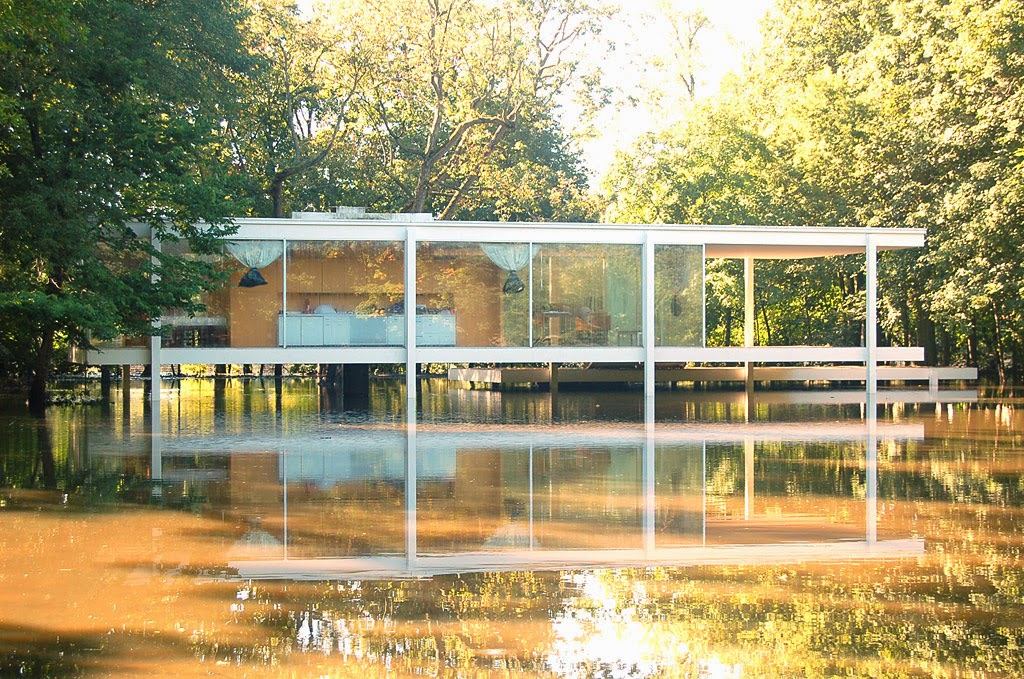
Another International style house designed by Ludwig Mies van der Rohe, The Farnsworth House was constructed and designed between 1945 and 51. As you can see there's a lot of symetry and nautraly light. the materials used to build this house are metal and glass. No historical ornament and very pure with the white.


About.com. 2013. architecture. [ONLINE] Available at: http://architecture.about.com/od/greatarchitects/p/lecorbusier.htm. [Accessed 02 December 13].
About.com. 2013. international style. [ONLINE] Available at: http://architecture.about.com/od/20thcenturytrends/ig/Modern-Architecture/International-Style.htm. [Accessed 02 December 13].
merriam-webster. 2013. international style. [ONLINE] Available at: http://www.merriam-webster.com/dictionary/international%20style. [Accessed 02 December 13].
bc.edu. 2011. LeCorbusier -- Villa Savoye. [ONLINE] Available at: http://www.bc.edu/bc_org/avp/cas/fnart/Corbu.html. [Accessed 02 December 13].


Saturday, 30 November 2013

Any Shape as Long as its Geometric

Bauhaus

With De Stijl and Constructivism, the Bauhaus was and is one of the most influential sources of modern design. Bauhaus was the real deal it was the best school with the best pupils and best designers, architects, painters and etc. Walter Gropius  was the leader of Bauhaus which meant building house, he was a architect, he believed the truth to material - the material used for an object should be appropriate for it purpose and form follows function - form should be modern, abstract and functional with universal appeal.


Bauhaus had famous teachers such as Paul Klee, Wassily Kandinsky, and Lazslo Moholy Nagy. The characteristics of Bauhaus were; geometry, simplicity, straight lines, smooth curves, industrial look, connection between colour, clean typography and affordable for every class person. They were taught about materials, colours, contrast as well as the appreciation of art history. The Bauhaus promoted the use of materials such a tubular steel. Material that had not been used previously in furniture design or even considered as a suitable material for furniture. Tubular steel is light, versatile and cheap. It can be joined, shaped and formed in different ways, opening up new design possibility. This was the design philosophy of the Bauhaus.

Marcel Breuer was a student at Bauhaus completing the basic course of carpentry, during his tuition he designed his African chair and Slatted chair. After finishing his studies he worked in an architectural office and after a year he became a young master and became the head of the carpentry workshop of Bauhaus which by then had moved to Dessau.

 During that time he designed his first tubular metal chair named the B3 which was inspired from his Adler Bicycle. He then designed a whole range of furniture with tubular metal including, chairs ,tables, stools and cupboards.


It's amazing how the B3 was designed years ago and can still be found in shops for sale. Today's dining chairs also look simmilar to what Breuer designed for example: 


This chair is designed from a designer named C.Werner it looks very similar to what Breuer designed and it's also simple, sleek and look very comfortable.


Another design from today's Designers Muller and Van Severen,  which look very similar to what Breuer did. The leather is attached just like he used to attach it, it's really simple and it's also made from tubular metal, geometric shapes straight lines and very smooth sleek curves. These pieces look really comfortable and they certainly do remind me of Bauhaus. 


technology student. 2010. the bauhaus. [ONLINE] Available at: http://www.technologystudent.com/prddes1/bauhaus1.html. [Accessed 30 November 13].
female ways . 2009. Modern Dining Room Leather Chairs Design by C. Werner. [ONLINE] Available at: http://www.femaleways.com/dining-room-design/modern-dining-room-leather-chairs-design-by-c-werner/. [Accessed 30 November 13].
fmuller van severen. 2013. a furniture project by fien muller and hannes van severen. [ONLINE] Available at: http://mullervanseveren.be/site/. [Accessed 30 November 13].


Friday, 29 November 2013

De Stijl

De Stijl began in the 1917s at first it was a magazine but the a group of like minded Dutchmen planned to call themselves De Stijl. De Stijl was led by architect and painter Theo Doesburg and Piet Mondrian. They used primary colours, red, blue and yellow and they also used the 3 primary values which are black white and grey. All surfaces were painted in primary colours and then divided with straight black lines which was called Neo-plasticsism. They used straight veritcal and horizontal lines, and simplicity. In architecture they kept the roofs flat, geometric forms, patterns and rectangular shapes.

Another desinger who joined later on was Gerrit Rietveld, he always liked experimenting with wood. One of his most famous pieces is the Red/Blue Chair, it purity, spatial harmony, straight lines and firm angles.


Rietveld also designed a house in Utrecht it was called the Schroeder house. He designed it just like every other thing that had to do with De Stijl.


He gave it a flat roof, primary colours and striaght black likes cutting through. As you can see the inside matches the outside and it also have the same colours used. It's all designed in geometric forms and it also has that space he wanted. There's repetition of shapes and simplicity. Today our contemporary homes do have the same form/shape of what Rietveld and the other designers designed but less colour and brightness.


This house design is designed by Steven Ehrlich Architects. Its easy enough to see the comparison between the two houses. Both of them have block shapes, geometrical, repetition of the same shape and straight simplicity of lines. The only difference is the colour. Another design I knew about which was inspired by De Stijl is an album cover which belongs to the White Stripes.


Simplicity, geometry, repetition of shapes, neo-plasticism and straight lines.


LAURA CASEY INTERIORS. 2008. mondrian really?. [ONLINE] Available at: http://www.lauracaseyinteriors.com/blog/2008/12/11/mondrianreally/. [Accessed 29 November 13].
Clark & Freeman, P C & J F, 2003. a crash course design. 1st ed. china: sophie collins.


Revolutionary Russia

Constructivism

It first started after the WW1 in Russia 1917 - 1922 and was used as a political tool, it was about putting art to the service on constructing a new society. Constructivism was influenced by cubism and Italian futurism. the charateristics of constructivism were geometry, abstract, clean lines and flat colours. constructivism was in textiles, graphic design, film, theatre and they also developed the photo montage. 

Aleksander Rodchenko was one of the first to experiment with photo montage and he also designed furniture, posters, books & typographic, believing these forms of art to be more effective is communicating the messages of the soviet union. He became one of the most important leaders of constructivism (whose followers favoured strict geometric forms and crisp graphic design) in Russia. During the movement he formed the first working group of Constructivists.

Rodchenko also did a photo montage illustrations for Mayakovsky’s poem “Pro eto" and also all of Mayakovsky's book covers. His graphic designs were very flat with only limited colour palette of only black, red, white and greys also letters of the alphabet taken from photographs.


Varvara Stepanova was Aleksander's wife, she was also a painter, designer and photographer. She spent her career dedicated to trying to use her work to create revolutionary change within society. She designed books, textile designs for costumes. Stepanova was also a leading figure of the contructivist movement and also designed textiles from 1923 to 1924 for the First state textile factory. She designed 150 bold geometric textiles of which 25 or so were put into production. Stepanova concentrated on graphics and worked with her husband Aleksander on posters, books, magazines and typography.


aleksander rodchenko. 2009. biography. [ONLINE] Available at: http://aleksandrodchenko.wordpress.com/. [Accessed 29 November 13].
design history. 2012. vervara stepanova. [ONLINE] Available at: http://www.designishistory.com/1920/varvara-stepanova/. [Accessed 29 November 13].
Thames & Hudson, T & H, 2004. design since 1900. 2nd ed. singapore: c.s graphics.


Frank Iloyd Wright


Frank Lloyd Wright was first known as an architect though he was also a design theorist.he was interested in Japanese architecture combined with Sullivan's influence to produce a style that departed from European ideals and embraced organic design. his characteristics on architecture were, horizontal lines, a tendency to sit low in the landscape, asymmetry, simplicity and use of natural materials.


The Kaufman house better known as the falling water overlaps a stream and as i described before you can see that it has horizontal lines, the design of the house doesn't 'pop' out of the landscape it looks like it's one and perfectly designed. it's simple and it also has asymmetry, the materials used for the building of this house were wood and stone and reinforced concrete. 

Today we still have buildings built in this shape and form and we still call it contemporary. Through my research i have found a house which reminded me of what Lloyd believed in by making the house merge into its surroundings.


As you can see it's form is exactly how Lloyd used to design. It merges right into its surroundings and doesn't look out of place. Its asymmetrical and the materials used for this hows if exactly the same that he used to build. This design belongs to Alexa. 


oiide. 2013. Rectangular Shape Of White Home Design With Swimming Pool Built In Natural Surrounding. [ONLINE] Available at: http://www.oiide.com/picturesque-and-dashing-contemporary-architecture-design/rectangular-shape-of-white-home-design-with-swimming-pool-built-in-natural-surrounding/. [Accessed 29 November 13].
thames & hudson, T & H, 2004. design since 1900. 2nd ed. singapore: c.s graphics.