Sunday, 19 January 2014

Chart Concept 1

Streamlining - Raymond Loewy, The man who designed everything:


Raymond Loewy is one of the most creative designers in the 20's. He designed everything from a packet of cigarettes to coca cola bottles, refrigerators, sharpeners, cars, planes even NASA's Space Stations. Truly one intelligent man which started off as a French Army second Lieutenant in WW1. When he arrived in america he started working as a window dresser for Macy's and then as a fashion illustrator for 5 years with Vogue, Harper's Bazaar and Vanity Fair etc.

He had his own industrial design office were he used to make models out of clay which had smooth sleek form. He then used the technique later on for automotive designs. His car designs were less box-like and he also designed a refrigerator which was his first domestic appliance. He remodelled buses-coaches for Greyhound and designed his 'Champion' car for Studebaker. He also did logos like Shell and Exxon.


         Loewy partnered with four other designers which he called his associates which grew and started taking bigger projects such as architecture. Loewy was the first designer to be on the Time magazine and he was also called out from the Government to design a plane for John F Kennedy. Raymond Loewy is the greatest leader of streamlining in the 20th century. I chose Loewy because his designs are brilliant and so glamorous. I always liked Streamlining but I've never really bothered  to research any designers. Learning about him was inspiring for me, because he designed whatever they asked for and every design he did is grand.

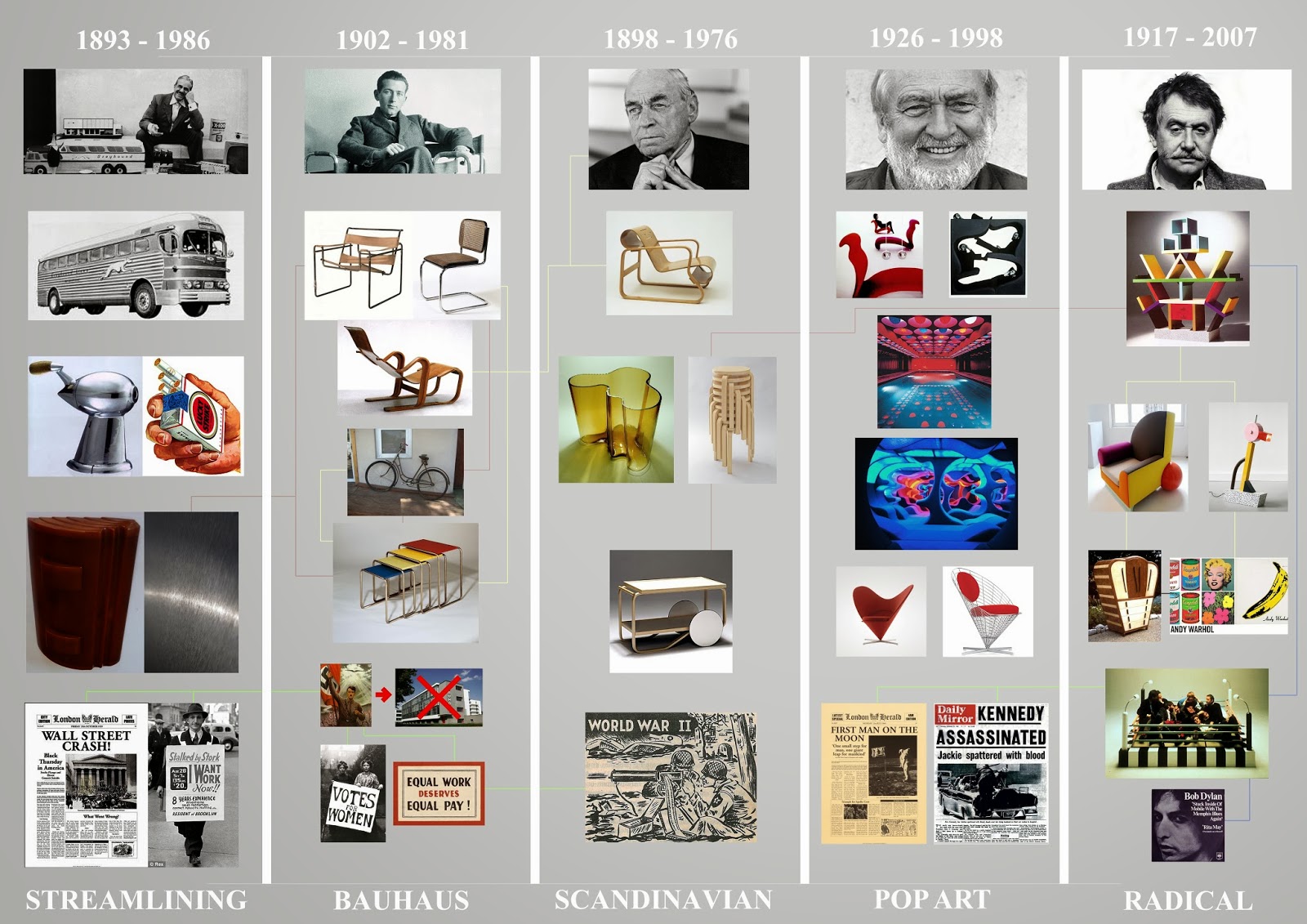
Task 2 Individual Work - Visual Chart


To Create my Visual Chart I chose to use Adobe Photoshop.

Notes on Visual chart:
The yellow lines show influences the designers and movements had, for example Marcel was influenced by Alto and his bicycle influenced him on his designs. Sottsass was influenced by pop art with its beautiful bright colours, also Art Deco shapes.

Red lines show the same material other movements used. Streamlining and Bauhaus used metal and Alto and Sottsass both used wood.

Green lines show what was happening through those years of the design movement. Scandinavian, streamlining and Bauhaus all had something to do with the Nazi and with people losing their jobs, without money and no place to live. During Bauhaus Women fought for their rights, to vote and to get equal pay why would a person working the same hours as others are and not want to have the same pay? World War 2 effected both Bauhaus and Scandinavian design. Both pop art and radical design experienced two memorable event which both effected them in design. The grand idea JFK had brought up and said that america will be able to put the first man on the moon and also later on they experienced a sad moments when he was shot dead in front of a big crowd in a roofless car with his wife.

Blue lines show the group of Memphis the song were they got the name from, while at Sottsass talking about the ideas he had for this group and a design the Memphis group design together.

I'm happy with how my Chart came out in the end, it's exactly what I wanted, no crowding, everything nicely put and certainly not confusing to realise what's happening between the movements, the designers and through the years of their designing on which influences they had and on why or what the had to design for,


Monday, 13 January 2014

Philippe Starck

Philippe Starck has said that he can design a chair in two minutes and a hotel in a day and a half. He prefers to work alone, sometimes “naked in the bedroom,” the Frenchman has invented thousands of products, interiors, and buildings for clients ranging from Microsoft to Baccarat.

In the begining he stopped studying architecture to work for fashion designer Pierre Cardin. In the Beginning of the 80s he achieved wide publis approval by designing furniture for president Mitterrand's private suite. in the Elysee Palace. He designed furniture for furniture companies such as DRIADE and a set of shelves for the company Disform. His designs show strong bio morphism - A surrealist art movement of the twentieth century that focuses on the power of natural life and uses organic shapes, with shapeless and vaguely spherical hints of the forms of biology, which influenced a lot of designers in the late 80s.

Philippe claims that he can design chairs in less then 15 minutes, which means that obviously he is supported by a strong back up team. He designed toothbrushes, pasta and a lemon squeezer which is quite famous and was in the homes of the early 90s chic.

The Lemon squeezer was quite an interesting design, also unique and how he came up with the idea is way more interesting. He was having lunch and ordered calamari and noticed that he didn't have a lemon so he asked the waiter for one. While squeezing the lemon Starcks came up with this grand idea-design and started drawing it on a napkin which he had infront of him.


Today the napkin is held in a museum and the squeezer made a great hit. He designer this for Alessi and this was not only his famous design but another which I do like is the Ghost chair. I couldn't help but realise while walking in Victoria Gozo to go have some coffee that a Cafeteria - Kozmo has Starck's look alike chairs inside and out and so I went to try them out I was so tempted that I had to see if they were comfortable. Here are the pictures below.

First Design of the Ghost chair:


The chairs I found at the cafe:


His first design was clear plastic but had no colour, these days they do them in any colour possible and they still do sell them or similar designs as you can see.


Fiell, C & P F, 1999. design of the 20th century. 2nd ed. china: ISBN.
Thames & Hudson, T&H, 2004. design since 1900. 2nd ed. singapore: C.C Graphics.

Design

Design for safety

Awareness which started in the 60s with the publication of the book:
“Unsafe at any speed: the designed- in dangers of the American auto mobile” by Ralph Nader 1965


The development of products making them safer to use.
The design of safety equipment such as:

  • Fire extinguishers
  • seat belts
  • air bags
  • smoke alarms.


These are manufactured according to guidelines and standards set by a specialized committee and there standards are included in legislations which govern product design and manufacture. In the toy industry products which comply with the European directives bear the mark CE this enables the products to be exported and imported in the member countries. 


Design for sport

Design for sport involves pushing materials and technologies to their limits. Sport equipment relies on research and development and designs are usually made with the latest computer technologies and in accordance with ergonomic data.
• Designs to improve performance – helmets biker safety and etc
• lightweight materials
• carbon fiber  (helmets)


Design for the third world

The aim to empower developing nations to meet their own needs making economic and environmental sense.

• Wobo (world bottle) 1960


• Pedal powered washing machines
• Motivation wheel chair design for landmine victims making used of locally available components
• The hippo


• The sierra portable light mat from portable light team. This has flexible solar cells from people around the world for people who don’t have power.


Design for children

• Miniaturization
• reduction of scale results in less weight
• Less material
• Cheaper to manufacture
• Generates less waste


All notes were taking during class.

Sustainable Design

Sustainable design describes a design philosophy that values the natural environment as an integral factor in creating new products or modifying old ones.Sustainable designs try to maximize overall efficiency with surrounding resources, such as transportation such as well as energy efficiency, habitat preservation and restoration, natural and renewable energy sources, water conservation, recycled, local and non – toxic materials, and healthy and productive interiors.
Learning about green buildings; environmentally friendly and cradle-to- cradle design; when designing you’re already thinking of how it can be reborn again.

Planned obsolescence; how long the product is going to stay good and how much it will be used. It’s based on the concept of intentionally limiting the life of products so that the consumers are manipulated into consuming more.

The conflicting views:
1. Keeps workers/designers in employment and helps the economy
2. Waste is created by the premature replacement of the commodities

For example batteries, unless they are un rechargeable they’re useless. They’re also things you’d buy while knowing you’d be throwing it away for example Gillette razors and Make up refills instead of buying the whole products again.


Planned obsolescence can arise from:
1. Change in appearance/style: cookers from others and microwaves
2. Change in technology: from Samsung s4 to Samsung s5

Cradle to cradle:
It’s a method to minimize the environmental impact of products by employing sustainable production operation and disposable practice and aims to incorporate social responsibility into product development
Under the cradle to cradle philosophy products are evaluated for sustainability and efficiency in manufacturing processes material properties and toxicity as well as potential to reuse materials through recycling or composting.


Notes were taken in class.

Wednesday, 8 January 2014

The Memphis Group

The Memphis group was a group of Italian designers and architects who created a series of highly influential products in the 1980's. it was founded in Milan and their aim was to refresh, strengthen the radical design and to design a new creative approach to design. The leader of the group was Ettore Sottsass and the name Memphis came from the song Memphis blues which belonged to Bob Dylan. While listening to music with his ‘group’ at his house planning about their new group Ettore came up with the idea to name it Memphis. The Memphis groups designers were Ettore Sottsass, Michele De Lucchi, Maro Zanini, Mateo Thun, Nathalie de Pasquier and George Sowden. 


They made beautiful and bizarre designs, with bright vibrant colours, textures, use of different materials, well several materials in one most often and the intentionally mocked the presentations of good design.

Martine Bedine, Super Lamp for Memphis


They convinced Abet to make new laminates printed with extraordinary vibrant patterns inspired by pop art, op art and electronic imagery.


Ernesto Gismondi became the head of the group later on and on the 18th of September 1981 the group showed their work for the first time. All designs were designed by an international group of architects and designers inclugin Hans Hollein, Shiro Kuramata, Peter Shire, Javier Mariscal, Massanori Umeda and Michael Graves. The group always agreed, accepted the Memphis was a trend/phase tied to the briefness of fashion and in 1988 when its popularity started to decrease Sottsass separated it. Although Memphis was a short lived phase its youthful vitality and humor was central to the internationalization of post modernism.

Through my research I've found a fashion show Dior made with inspiration from the Memphis Group's designs.


mirror 80. 2011. Memphis Design Meets Haute Couture: Christian Dior’s Fall-Winter Collection. [ONLINE] Available at: http://mirror80.com/2011/07/memphis-design-meets-haute-couture-christian-diors-fall-and-winter-collection/. [Accessed 08 February 14].
juilies juice. 2011. memphis dior. [ONLINE] Available at: http://juliesjuice.wordpress.com/category/memphis-design/. [Accessed 08 February 14].
Thames & Hudson, T&H, 2004. design since 1900. 2nd ed. singapore: C.C Graphics.


Monday, 6 January 2014

Post Modern Design

Pop modern design is possibly one of the most scandalous and notorious movements in design. Architects and designers argued that modern architecture was basically meaningless. Post modernists were bored with all the inspiration from science and universal truths from the modernists. Modernists believed that less was more but for the post modernists less was a bore. Post modernists believed that we needed as many references as possible to find out individual subjective conclusions. They believed in collage, anarchy, repetition these were extremely interesting. The post modernist designers wanted to challenge the audiences and force them to ask questions. Buildings now became fancier and more interesting also nice to look at such as the buildings in Vegas which have different styles, cultures and playful collages.


Critics disapproved unnecessary ornamentation and obsessive tendency to recycle the past to make something new and regularly plain silliness. Mass media helped post modernism grow, the world related together like never before. Post modernism was liberating, designers did what they wanted and what felt right for them and didn’t go for ‘rules’ like other movements had. Their designs were often funny, sometimes confrontational and occasionally absurd. They had bright colour, theatricality and exaggeration: everything was a style statement. Whether surfaces were glossy, faked or purposely distressed, they showed the desire to combine rebellious statements with money making appeal. Designs didn't have much functionality other than decoration.

Roland Barthes believed that if objects and buildings were full of symbolism viewers and consumers will relate to them more. Music and magazines were the most important delivery system for this new period.
Post modernism divided the line between day wear and evening wear, formal and casual fusing them in a single style it even merged fine arts and mass culture too. Architect Michael Graves and others presented a new artistic, appealing visual in architecture by the mid-1970s.


Michaels building is known for its small square windows, exaggerated historical motifs, playful, different materials, tacky loud colors, and, of course it’s the larger-than-life statue over the building’s front door.
It was like you were grabbing a functional object and just adding decorations on it to make it look different, ‘prettier’ and nice, link in the pictures below.

Michael Graves Tea and Coffee Piazzo for Alessi


Proust, Alessandro Mendini


Anna g corkscrew, Alessi and Alessandro Mendini


a/n blog. 2014. MICHAEL GRAVES’ PORTLAND BUILDING COULD BE IN JEOPARDY. [ONLINE] Available at: http://blog.archpaper.com/wordpress/archives/77982#more-77982. [Accessed 06 January 14].
v&a. 2012. postmodernism. [ONLINE] Available at: http://www.vam.ac.uk/content/articles/p/postmodernism/. [Accessed 06 January 14].
youtube. (2013). Postmodernism: Design in a Nutshell (6/6). [Online Video]. 08 May. Available from: http://www.youtube.com/watch?v=lKomOqYU4Mw. [Accessed: 06 February 2014].